
You can edit basic MP3 tags in Windows 11 through File Explorer, but a dedicated tag editor gives you clearer control over title, artist, album, year, genre and comments. This guide explains both methods and shows how to fix files that still display the wrong information.
Quick method: edit MP3 tags in File Explorer
- Right-click the MP3 and choose Properties.
- Open the Details tab.
- Click the value beside Title, Contributing artists, Album, Year, Genre or Comments.
- Enter the corrected information.
- Select Apply, then OK.
This method is useful for a few ordinary MP3 files. The available fields depend on the file format and Windows property handler, and some files do not permit every field to be changed.
What are MP3 tags?
An MP3 filename and its embedded metadata are separate. Renaming track01.mp3 does not automatically change the title shown by a phone, car stereo or media player. Most MP3 metadata is stored in an ID3 tag inside the file.
| Tag field | Example | Where it is commonly displayed |
|---|---|---|
| Title | Morning Walk | Now Playing screen |
| Artist | Example Artist | Artist library and track list |
| Album | Weekend Sessions | Album view |
| Track number | 3 | Playback order |
| Year | 2026 | Sorting and information panels |
| Genre | Podcast | Genre filters |
| Comment | Edited master | Detailed properties |
Edit ID3 information with Music Editor Free
Music Editor Free includes a tag-editing workflow alongside its waveform tools. It is useful when you are already cutting, recording or applying effects and want to correct the text metadata before the final export.
Explore Music Editor Free for Windows 11/10
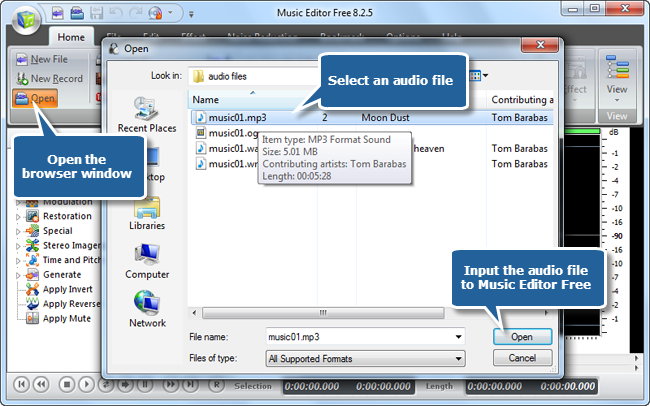
1. Open the audio file
Open a copy of the MP3 you want to change. Keeping the original is especially important when the same session will also modify the audio.
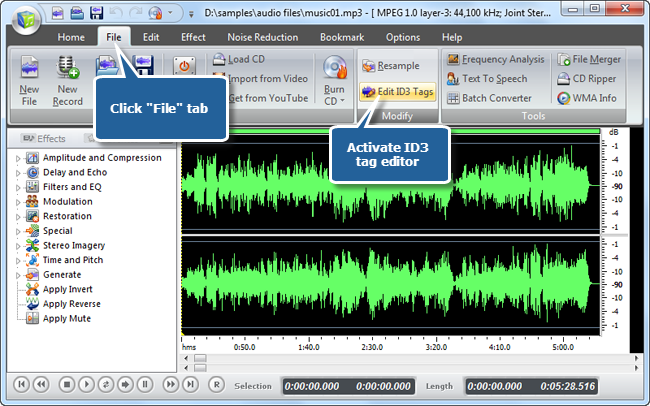
2. Open the tag editor
Activate the tag editor from the application’s tools. Review the existing values before replacing them; a spelling or punctuation difference can cause one album to be split into several groups in a media library.
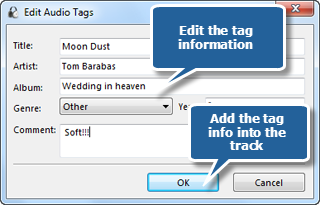
3. Enter consistent metadata
Correct the title, artist, album, year, genre and other available fields. Use exactly the same artist and album spelling across related tracks. For track numbers, use a consistent pattern throughout the album.
4. Save and verify in another player
Save the file under a clear name, close it and reopen it in Windows Media Player or another player. Verification matters because media libraries may cache old metadata and may not refresh immediately.
File Explorer or a dedicated tag editor?
| Need | File Explorer | Dedicated editor |
|---|---|---|
| Change a title or artist on one MP3 | Usually sufficient | Also works |
| Review all fields clearly | Limited view | Better suited |
| Edit while trimming or cleaning audio | No waveform editing | More convenient |
| Change hundreds of tracks | Cumbersome | Use a specialist batch tagger |
| Manage embedded cover art | Limited | Use a tool that explicitly supports artwork |
Why the new tags do not appear
The media library is showing cached information
Close and reopen the player, remove and re-add the file, or ask the application to refresh its library. Test the MP3 in a second player to determine whether the tag or the library cache is the problem.
The file is read-only
Right-click the file, open Properties and check its attributes. Files on read-only media, protected folders or some network locations cannot be changed until they are copied to a writable location.
Cloud sync restored the older copy
Pause editing conflicts and wait for OneDrive or another sync service to finish. Confirm which local path the media player is actually reading.
Different ID3 versions contain conflicting values
An MP3 may contain older and newer tag formats at the same time. Different players can prefer different values. A specialist tag editor can help remove duplicate or conflicting tag versions.
The player retrieved information from the internet
Some library applications use online data or their own database instead of the embedded tag. Turn off automatic replacement where possible and verify the tag directly in file properties.
Tagging tips for a clean music library
- Choose one spelling for each artist and album.
- Do not put the track number inside the title field.
- Use Album Artist consistently for compilations when your tagger supports it.
- Keep a backup before running any batch change.
- Test two or three files on the target phone, car or player before updating the full library.
- Remember that changing tags does not improve audio quality.
Frequently asked questions
Does renaming an MP3 change its title tag?
No. The filename and embedded title are independent. Many players display the title tag and ignore the filename while browsing the library.
Can Windows 11 edit several MP3 tags at once?
File Explorer can apply some common values to several selected files of the same type, but a specialist batch tag editor gives you more control and safer previews for a large library.
Will editing tags reduce audio quality?
Changing metadata should not re-encode the audio stream. If you also edit the waveform and export a new MP3, that separate audio export may involve lossy encoding.
Can I add album artwork?
Artwork support varies. Use a tag editor that explicitly supports embedded cover images, keep the image square, and test it on the devices that will play the file.
Which tags matter most?
Title, artist, album and track number have the greatest effect on normal library organization. Year, genre, album artist and artwork are helpful when the player supports them consistently.
Next steps
Correct the tags before copying files to a phone or rebuilding a media library. If the audio itself also needs work, follow the guides to trim an MP3 on Windows 11 or reduce background noise.